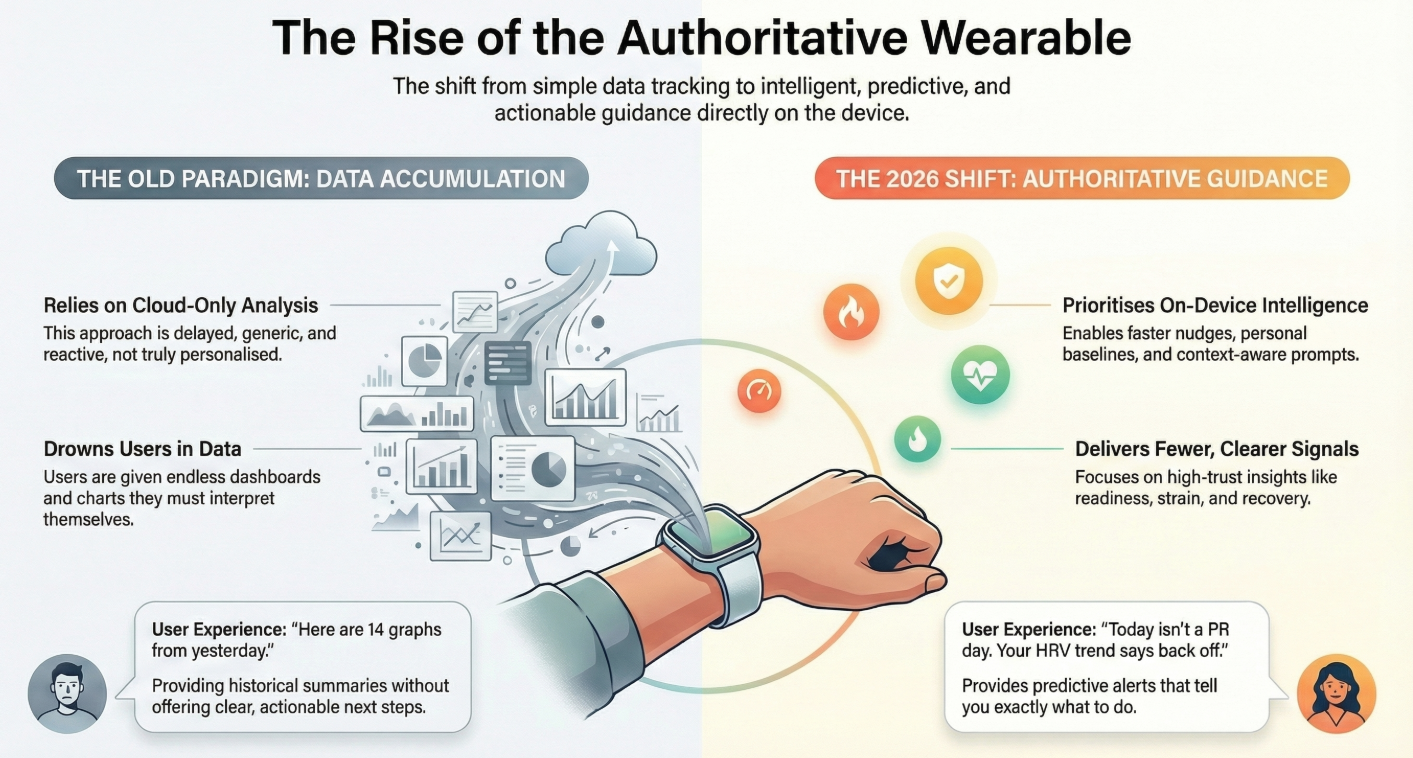
2026 will shift wearables from “what you track” to “what your device understands on its own.”
Features and sensors are only half the story.
The real battleground is on-device data processing.
Why on-device intelligence matters now
Every added sensor generates raw data.
Raw data is useless without:
- continuous processing
- contextual baselines
- predictive interpretation
Cloud-only analysis is cheaper.
But it’s delayed, generic, and reactive.
Users don’t want more charts.
They want decisions made for them.
The WHOOP effect: FOMO wasn’t about hardware
WHOOP didn’t win because it had more sensors.
It won because it withheld the data and surfaced meaning.
No step obsession.
No endless dashboards.
Just clear signals:
- strain
- recovery
- sleep debt
- readiness
That created FOMO not through features — but through predictive restraint.
People didn’t feel informed.
They felt guided.
Where 2026 wearables are heading
As storage and sensors get selectively trimmed on entry models, something else increases in importance:
On-device computation + inference.
This enables:
• rolling personal baselines (not population averages)
• faster nudges without cloud latency
• context-aware prompts (sleep, stress, training, recovery)
• predictive alerts instead of historical summaries
Example users actually care about:
“Today isn’t a PR day. Your HRV trend says back off.”
Not:
“Here are 14 graphs from yesterday.”
The trade-off brands are making
In 2026, many brands will choose:
- fewer sensors
- less raw storage
- tighter feature sets
But invest in:
- better on-device models
- smarter readiness scoring
- clearer, fewer nudges
Because analysis beats accumulation.
The new user preference
Users are done with:
• exporting data
• interpreting charts
• deciding what matters
They prefer:
• predictive nudges
• confidence over control
• fewer insights, higher trust
The uncomfortable truth
The best wearables in 2026 won’t feel “powerful.”
They’ll feel quietly authoritative.
And the biggest FOMO won’t come from missing a sensor.
It’ll come from missing the moment when your wearable tells you exactly what to do — before you even ask.
Leave a Reply